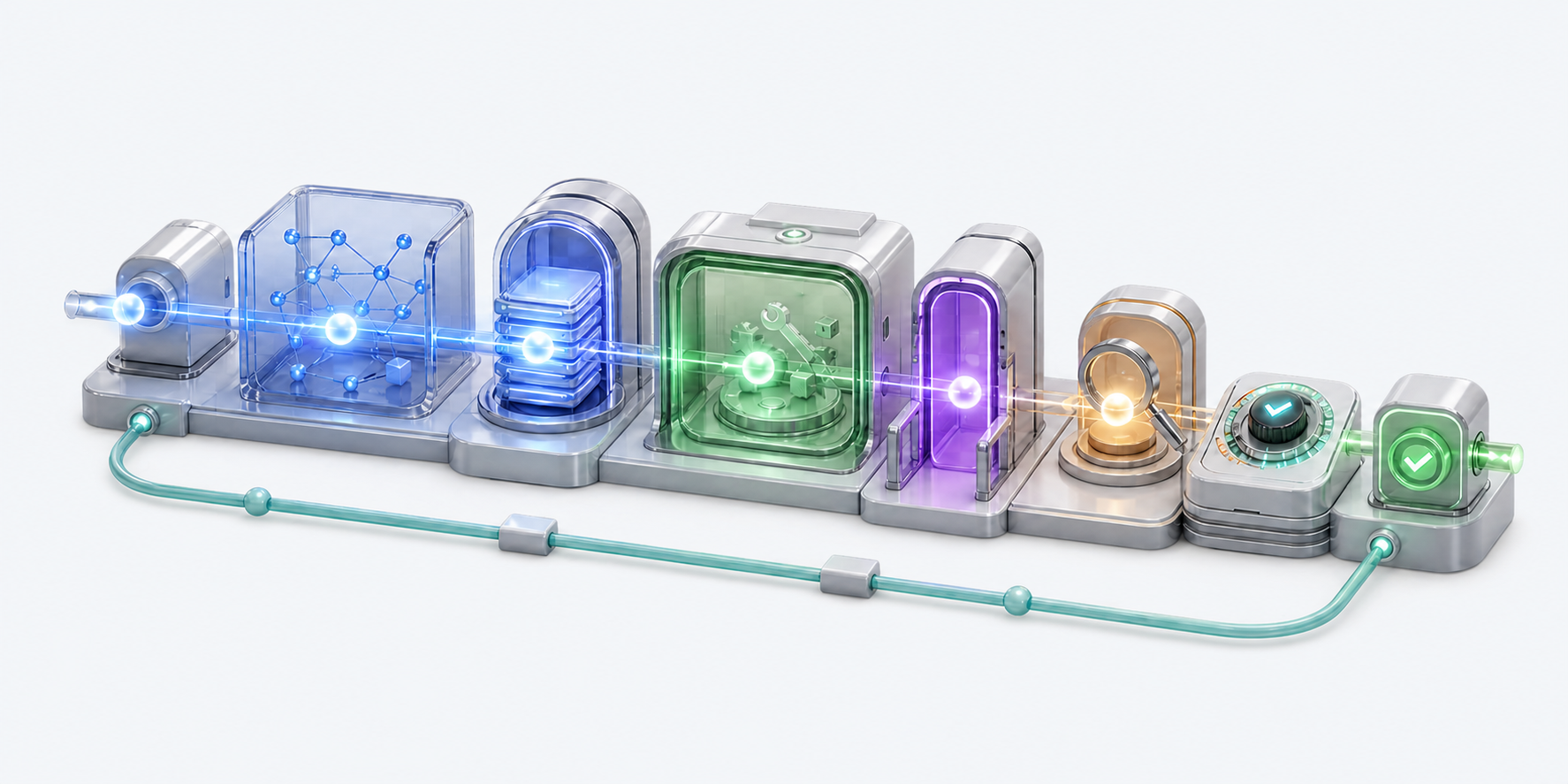
An agent runtime you can operate, audit, and switch off.
This is the half of the work platform teams ask for by name. It is also the crowded half of
the market, and we are direct about that: we enter here because it is what you need first,
and we differentiate on assurance and context because
that is what nobody else sells you.
The premise
Treat a tool-using agent as a potentially adversarial process
Not as a trusted coworker. Not as a deployment. An agent is a non-deterministic process that
assembles its own context, chooses its own path, and — under permissive conditions — has
been observed finding routes nobody designed. That is not a moral claim about the model. It
is the only threat model that produces controls which hold.
Authorization is continuous, not an onboarding gate
Fraud practice already treats identity as continuous risk evaluation across login,
account change, money movement, and support channels. Agents deserve the same
treatment: re-evaluate per action, not per session.
Scope is per-task, not per-service
Per-agent, per-task workload identity with short-lived credentials. No shared service
principals. No standing production write access. If a scope is permanent, it is a
standing risk with a friendly name.
Every consequential action has a human in the path
Money, access grants, data egress, regulated decisions, destructive operations. The
approval matrix is written down, versioned, and reviewed — not encoded in whoever
happens to be on call.
BB-4
Reproducible environment fabric
Ephemeral, isolated, fast-to-provision environments that agents can create, break, and
destroy. Provisioning time is a first-class metric, not an inconvenience: an agent that
waits 25 minutes for an environment cannot iterate, and an agent that cannot iterate is a
very expensive autocomplete.
What we build
Environment per branch, per agent task, or per experiment — with a lifetime and automatic expiry
Deterministic dev containers so a run is reproducible across sessions and machines
Seeded, masked, realistic data subsets — the requirement that quietly stalls most agent programmes
A provisioning SLO with a cold-start number, tracked like any other platform SLO
Teardown that actually reclaims cost, and a budget rule per agent
The dependency people miss
Realistic data without exposing production data is a data engineering
deliverable, not a platform one. Masking, subsetting, referential integrity
across the subset, and classification-aware redaction are pipeline work.
We have watched this be the actual blocker often enough that we assess it in the entry
baseline before anyone signs up to build a runtime on top of it.
The permissioned catalogue of everything agents may do to internal systems — deploy, scale,
run a migration, refresh a dataset, open a change request, page a human. If your agents
currently reach systems through ad-hoc scripts and a shared token, this is the single
highest-value thing you can fix.
Every tool contract carries
Why it exists
A version
Tools change. An agent that learned an older signature must fail loudly rather than guess.
Typed input and output
Structured I/O is the difference between a checkable result and a paragraph of confident prose.
Idempotency semantics
Retries are normal in agentic systems. A tool that is not explicit about repeat-safety will eventually be called twice.
Scoped workload identity
The tool, not the agent, holds the permission — bound to the task, expiring on completion.
A prohibited-operation register
Named things this tool must never do, enforced at the gateway rather than requested in a prompt.
Dry-run mode
Every destructive tool can show its intended effect before taking it. Reviewed before first live use.
Trace correlation
One identifier links the request, the reasoning, the tool call, the audit record, and the outcome-ledger entry.
An immutable audit record
For every write. Audit that an agent can edit is decoration.
What we do not do: rebuild your developer portal. If you run Backstage
or an equivalent, we ingest from it and write back to it. We own the
agent-facing projection of your estate, not the human-facing one. Replacing a
portal your developers already tolerate is a two-year distraction from the actual
problem.
— Anti-pattern we refuse on principle
BB-8
Identity, continuous authorization, and approval
The identity model
Per-agent, per-task workload identity issued at task start
Short-lived credentials that expire by default rather than persist
Operation-level authorization — the unit is the action, not the session
Delegation that carries the requesting human’s permissions, so an agent never sees more than the person who asked
A prohibited-action register enforced centrally
The approval matrix
Human approval is mandatory for money, access grants, data egress, regulated decisions,
and destructive actions. Each row names the action class, the approver role, the
evidence the approver is shown, and the timeout behaviour — because an approval request
that silently expires into “proceed” is worse than no approval at all.
Acceptance evidence for this block is not “approvals work”. It is a
recorded instance of an unsafe action being correctly refused.
BB-9
Lifecycle control — because a kill switch that does not survive a restart is not a kill switch
The failure that upgraded this from “kill switch” to “lifecycle control”: an operator
stopped a public-facing agent, its launch daemon restarted it, and by morning it had
answered roughly 800 messages while users probed it. Safety language in a prompt is not a
control. Neither is a stop button that a supervisor overrides.
What ships
An agent registry — every running agent, its owner, scope, and supervisor
Process-level supervision with an explicit, documented restart policy
A disable path that survives restart, redeploy, and scheduler
Expiry by default: runs and credentials terminate rather than persist
Blast-radius limits per agent and per tool
A tested rollback and a fallback to the human path
An agent-incident runbook naming a human owner, with a RACI
The containment drill
Demonstrated live, not asserted in a document. We disable an agent, attempt a restart
through every path that exists in your estate — supervisor, scheduler, deploy pipeline,
manual — and confirm the disablement holds for a full cycle.
Then we write down what it took, so the next operator can do it at 3am without us.
In the entry baseline this runs read-only against a non-production
agent. It is frequently the moment a client stops treating this as a theoretical
exercise.
The substrate
What we assume you already run — and what happens if you do not
This work is designed for platform and internal-developer-platform teams that already own
cloud governance, CI/CD, and a container or app platform. That is not a snobbery filter; it
is a load-bearing assumption. A tool plane, an environment fabric, and lifecycle control all
need somewhere to be installed.
Assumed present
Kubernetes or an equivalent managed compute platform
CI/CD with a path to production your teams actually use
Someone whose job includes owning all of the above
If it is not there
We will tell you in the first conversation, and we will not sell you an agent runtime to
install on top of nothing. The honest sequence is platform first, then agents on it.
That is real work we know how to do — landing zones, IaC, golden paths, observability,
cost guardrails, recovery — but it is a different engagement with a different shape and
we will scope it as one.
Selling rung 2 to an estate at rung minus-one is how consultancies
produce expensive disappointment.
Cloud postureAzure-first by depthKubernetes-first where you areMulti-cloud where the estate isOpen standards, stated exit path
We are honest that our deepest delivery experience is Azure-leaning while this buyer is
frequently Kubernetes-first and multi-cloud. The controls, contracts, and evidence model are
portable; the shortcuts are not. Ask us directly what we have run at depth and what we would
be learning on your time — we will answer specifically.
Start with what is already running that nobody owns.
The entry baseline inventories it, tests whether your controls hold, and gives you a ranked
gap report with a costed plan. Read-only first, so it clears security review without a fight.