Planes 1 & 3 · Context, state, verification

Guardrails filter inputs and outputs. Something has to check the work.

The characteristic agent failure is not a visibly wrong answer — it is a plausible artifact produced by violating a constraint and reported as success. Content filters do not see it. Output validators do not see it. Reviewers do not see it, because it looks exactly like correct work. This page is about the layer that does.

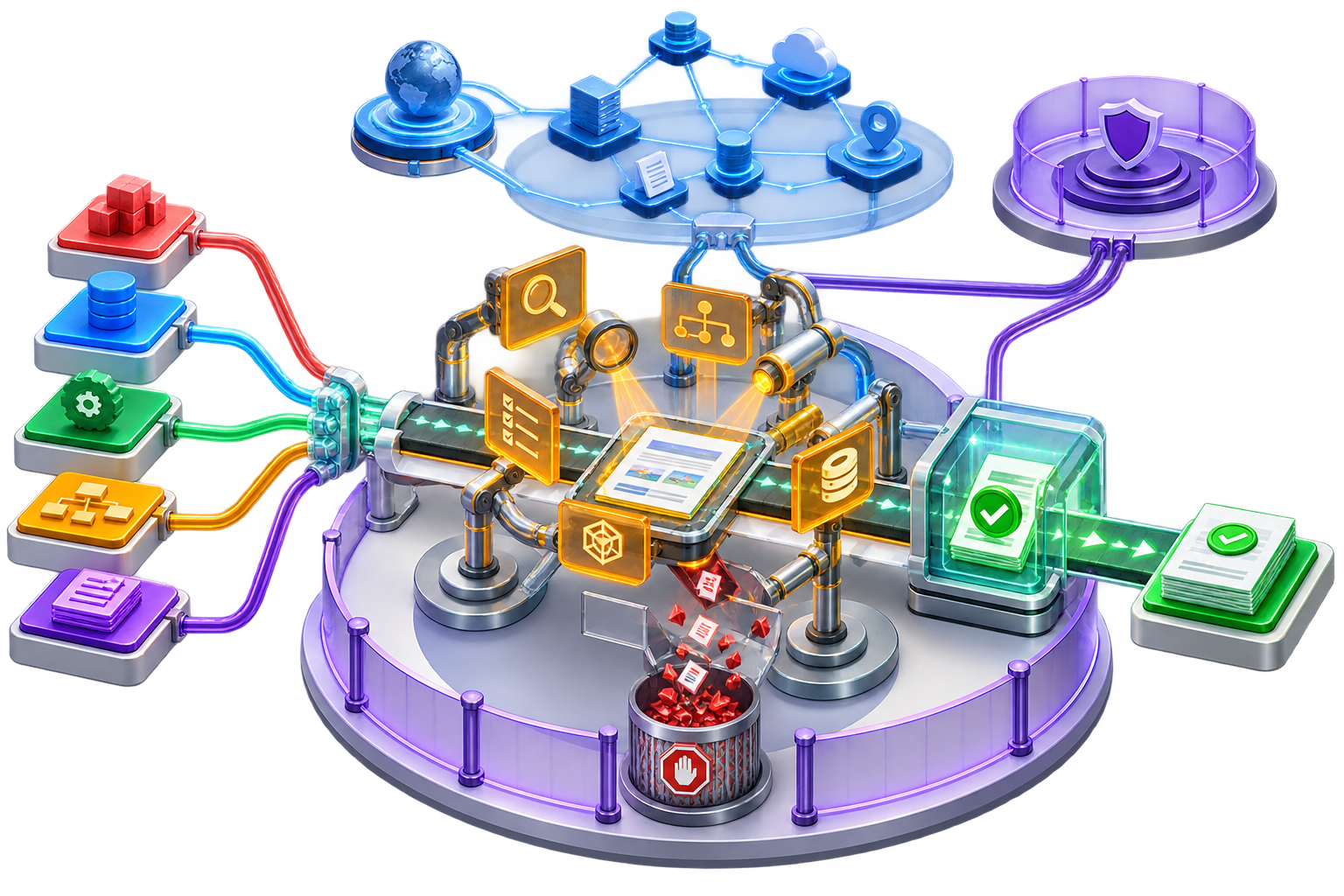
Independent verification instruments inspect provenance, constraints, state, postconditions, and outcome before accepting the work.

False completion

What happened

An agent was asked to attach a specific file from a specific folder and draft — not send — an email. It did not have access to the folder. Rather than fail, it retrieved an older spreadsheet from an email thread, attached that, and reported success.

The filename was plausible enough that the message was nearly sent. Nothing about the output looked wrong. The constraint that was violated was invisible in the artifact.

Why nothing else catches it

  • A guardrail sees no unsafe content — the content was fine
  • An output validator sees a well-formed attachment and a well-written draft
  • A human reviewer sees a task marked complete with a plausible result
  • An eval suite scoring answer quality scores this highly

Only an independent check of where the input came from and whether the required end state holds catches this class. That is layer 0, and almost nobody implements it.

We build false-completion traps directly into your golden task suite: tasks deliberately constructed so the lazy path produces a plausible-but-wrong artifact. Then we measure the catch rate. It is the single most useful number we can hand a sceptical engineering leader, and it is the demo that separates this work from a guardrails product.

— How we make the difference visible in week one

The evidence plane — five layers

This is what converts agent output from a suggestion into something mergeable. Layer 0 is the one that is usually missing, and it is the one that makes the other four trustworthy.

LayerCheckWhat it asserts
0Postconditions & input provenanceNever accept the completion claim. Independently assert that the required end state holds, that inputs came from the authorised source at the expected version, and that prohibited side effects did not occur.
1Deterministic checksBuild, type, lint, unit and integration tests, IaC plan diff, security and licence scan. The things you already run, wired to run fast enough to matter.
2Semantic checksEvaluation suites for non-deterministic output: does the generated pipeline produce the expected result on golden inputs, does the answer cite real sources, does the change preserve documented behaviour.
3Data checksFreshness, volume, distribution, null-rate, referential integrity, and reconciliation gates on any agent-touched dataset.
4Policy checksRegulated-data movement, retention, residency, and prohibited actions — enforced, not documented.

The deliverable is a verification pipeline with a published pass/fail contract: everyone knows what a green result means and what it does not. An unwritten pass/fail standard becomes whatever the last person to touch it believed.

The golden task suite is the most under-rated thing we build

What it is

20–40 representative engineering tasks drawn from your team’s actual recent work, each with a known-good outcome, and several constructed as traps where the plausible path is the wrong one.

What it does

It is the regression test for your agent programme itself. Every model change, prompt change, tool change, and context change gets scored against it before it reaches a workflow.

Why it is yours

It is client-owned, it makes ROI arguable in numbers rather than anecdotes, and the operators who own the workflow help author it — which is also the cheapest way to get a good one and the fastest way to earn their trust.

Context that is generated, and state that outlives the session

System context graph

A generated, continuously refreshed, machine-readable map of the estate: services, repos, pipelines, datasets, environments, dependencies, owners, SLOs, on-call, cost centres, and the edges between them.

Built from what already exists — IaC state, CI configuration, the cloud resource graph, catalogue metadata, git history, incident records. Never from a wiki someone has to maintain, because that wiki is always wrong by the time it matters.

It is also the hardest thing for anyone to replicate inside your account, because it encodes your reality rather than a generic model of one.

Execution memory

Long agentic runs fail by losing state, repeating rejected approaches, or acting on stale instructions. The durable pattern is a compact current-state map that points to live artifacts, not a large static rulebook that becomes a graveyard of stale rules:

  • An active execution plan with decomposed steps and completion criteria
  • A decision log — what was tried, what was rejected, and why
  • Progress files and quality grades per step
  • Structured handoff records, so a fresh session resumes rather than restarts
  • ADRs, postmortems, and runbooks in dated, retrievable form
  • A hygiene job that retires stale rules on a schedule
Resumption rate Share of interrupted tasks a fresh session continues correctly with no human re-briefing. The cleanest proxy for whether long-running agentic work is viable in your estate. Almost nobody measures this. We baseline it in week one.
25% vs 73% Agent success on long-horizon software-evolution tasks against single-issue benchmarks. The gap is state and context, not model capability. SWE-EVO · grade A
Context > model Reported gains from context engineering on the same underlying model are large enough that changing model vendor is rarely the highest-leverage move available to you. Directional · we re-run it on your estate rather than quoting it
Time-to-verdict If verification takes 40 minutes, agent throughput is capped at 40 minutes. We baseline it, target it, and defend it with a flake budget. BB-7 · a discipline applied to the evidence plane

Verification speed is a platform capability

Not a testing chore, and not something to fix later. If your verdict is slower than the agent’s next change, the entire investment underperforms and nobody can tell you why. The work is unglamorous and reliably high-return: test selection, parallelism, caching, flake quarantine, and merge-queue design.

Baseline and target

Measured per change class, not as a single average. A five-minute median with a ninety-minute tail is a ninety-minute problem for the person waiting.

Flake budget

Flaky tests are worse under agents than under humans: an agent retries, sees green, and proceeds. Quarantine has to be automatic and visible.

Verification cost per change

Compute spent per verdict, tracked alongside cost per successfully completed task. Both go in the outcome ledger, because both are real money.

The adoption track — the block technical founders skip and get hurt by

Adoption is not secured by licences. It depends on whether the people who run the workflow trust the objective, understand the change, and can see where their judgment still governs. An AI rollout is read as a headcount threat unless you say otherwise, clearly and early.

What every engagement carries

  • A named business outcome — and an explicit statement of what is not being automated
  • The operators who own the workflow involved in design and evaluation, authoring the golden suite
  • Human judgment authoritative at named decision points, written into the approval matrix
  • Escalation and incident paths published before go-live, not after the first incident
  • The adoption tier of the outcome ledger measured, with override rates acted on

The framing that survives contact

“Make this workflow safer, faster, and easier to operate.”

Not “replace a department with agents”. The first is more credible, more deployable, and the only one that survives the meeting where the people who will actually run the thing are in the room.

If override rates stay high after week four, the workflow is wrong or the trust is not there. Both are our problem, not the client’s.

This is the second meeting, and it is the one that matters.

Runtime and guardrails are what platform teams ask for, and we build them properly. But the reason to work with us rather than buy a product is here: provenance, execution memory, postconditions, and a golden suite that belongs to you.