Contracts become enforcement
A contract violation now produces wrong outputs at inference speed across every query touching the field — faster than any review cycle catches it. Machine-readable, CI-enforced, versioned.
Data is not a fifth plane in our model — it is the spine running under all four. Every control we build, every environment we provision, and every claim an agent makes about your business resolves to a dataset somebody has to vouch for. This is the part of the work that gets skipped, and it is the part that quietly decides whether the rest survives.
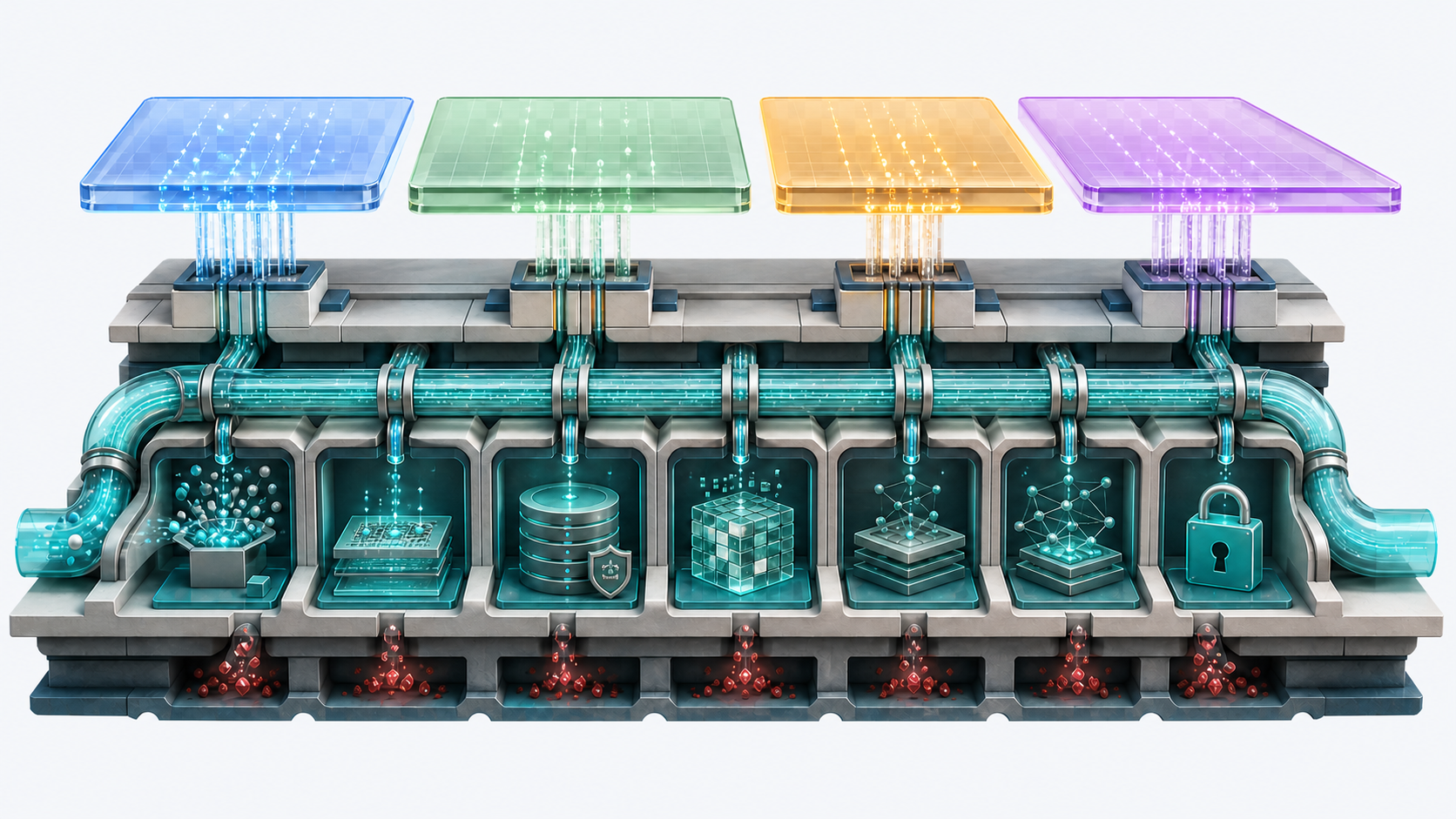
A crashed pipeline is the good case. It is loud, and somebody fixes it. The dangerous case is a pipeline that succeeds and produces wrong numbers, which then flow into dashboards, decisions, and now into agents that act on them without hesitating.
| Failure | What happens | How it is caught |
|---|---|---|
| Schema drift | Upstream adds, renames, retypes, or drops a column | Contract enforcement and schema tests |
| Freshness failure | The job silently did not run; the data looks normal but is stale | Freshness SLA monitoring |
| Volume anomaly | Partial load — 10% of expected rows arrived, everything still returns | Row-count and distribution checks |
| Fan-out | A join multiplies rows and every downstream sum inflates | Uniqueness and grain tests |
| Late-arriving data | Correct when read, wrong an hour later | Watermarks and a restatement policy |
| Null semantics drift | “Missing” starts meaning zero, or the reverse | Null-rate monitoring |
| Unit or currency change | A source switches cents to dollars and nothing errors | Range and distribution checks |
| Backfill inconsistency | Reprocessing yields different numbers than the original run | Deterministic transforms, backfill comparison |
| Permission drift | The pipeline runs as an over-privileged identity nobody has reviewed | Access review and workload identity |
This is the same insight as provenance and postconditions, in a different domain. The characteristic agent failure is a plausible artifact produced by violating a constraint and reported as success. The characteristic data failure is a pipeline that reports success and produces wrong numbers. In both cases the exit code is a lie, and only an independent assertion catches it. Data quality gates are layer-0 evidence for data.
— Why the same company should own bothAnalytical data was built for humans who apply judgment. An analyst sees a number that looks wrong and investigates. An agent consumes at machine speed, without scepticism, and acts on the result.
| Dimension | Human consumer | Agent consumer |
|---|---|---|
| Volume | Tens of queries a day | Thousands, unattended |
| Scepticism | Applies judgment to odd results | None |
| Ambiguity | Asks a colleague what “active customer” means | Guesses, confidently |
| Bad data | Notices and escalates | Propagates it into an action |
| Stale data | Sees the “last updated” timestamp | Does not look |
| Permissions | Inherits their own | Inherits whatever the pipeline identity has — usually too much |
A contract violation now produces wrong outputs at inference speed across every query touching the field — faster than any review cycle catches it. Machine-readable, CI-enforced, versioned.
Every dataset an agent reads needs a freshness SLA and a defined behaviour when it breaks: refuse, degrade, or escalate. Never silently serve stale data to an agent.
Proving inputs came from the authorised source at the expected version is lineage, for data. Without it, layer-0 evidence cannot be implemented for any data-touching workflow. A hard dependency, not a nice-to-have.
Benchmarks published in 2026 compared the same models answering the same questions two ways — raw text-to-SQL against tables, versus querying through a modelled semantic layer. No model was changed. The gain came entirely from data modelling work.
We flag those three figures as grade C precisely because the vendors publishing them sell semantic layers. That is why the deliverable is a benchmark on your data rather than a slide quoting theirs. Mechanically: a semantic layer exposes governed metrics and dimensions — typically over MCP — that the agent discovers and calls, so instead of inferring table structure and business logic it picks from defined metrics and the layer generates the SQL. It converts an open-ended reasoning problem into a bounded selection problem. That is the same lesson as context engineering in the code domain: the marginal return is in the substrate, not the model.
| ID | Capability | What it covers | Serves |
|---|---|---|---|
| D-1 | Ingestion & CDC | Landing source data reliably, incrementally, and replayably | Execution |
| D-2 | Storage & table format | Lakehouse layout, partitioning, retention, time travel | Context |
| D-3 | Transformation & modelling | Layering, grain discipline, tested logic, deterministic transforms | Context |
| D-4 | Semantic & contract layer | Governed metrics and dimensions, machine-readable contracts, CI enforcement — the agent’s data API | Context + Verification |
| D-5 | Quality, lineage & observability | Tests, freshness and volume SLAs, OpenLineage, anomaly detection | Verification + Control |
| D-6 | Governance & access | Classification, masking, workload identity, cost attribution, masked environment provisioning | Control |
D-4 and D-5 are where we invest, and where the market is thinnest. Ingestion and storage are commodity — buy them, and we will help you buy well. The differentiator is the contract, semantic, and evidence layer that makes data trustworthy to a consumer that cannot be sceptical on its own behalf.
— Where we build versus where we integrateEphemeral environments promise agents somewhere safe to work. That promise depends on realistic data that is not production data — which means subsetting with referential integrity intact, deterministic masking that preserves distributions and join keys, and refresh automation that keeps it useful.
Teams discover this after committing to a runtime, and it becomes the reason the programme sits at 80% for two quarters.
Assessed in the entry baseline, built at rung 2, before anyone depends on it.
Most engagements need both. Selling them as one thing produces a scope that cannot be estimated, and an estimate that cannot be met.
| Analytical / structured | Retrieval / unstructured | |
|---|---|---|
| The question | “What was revenue by segment last quarter?” | “What does our security policy say about vendor access?” |
| Substrate | Warehouse, models, semantic layer | Documents, extraction, chunking, embeddings, index |
| Failure mode | Wrong number, confidently | Wrong or outdated passage, confidently |
| Control | Contracts, tests, semantic definitions | Permission parity, freshness, supersession |
Grounding an agent in enterprise content makes latent over-sharing suddenly visible. Content that was technically readable by everyone but practically buried is now one question away. The agent did not create the exposure; it removed the obscurity that was hiding it.
Exclusion is cheaper than exposure. The boundary widens later, with evidence. And we report over-sharing as a finding for you to decide on — not as a blocker to quietly work around.
| Rung | Data content | Deliverable |
|---|---|---|
| 1 — Visible | Inventory of datasets agents already read or write; ownership; classification gaps; freshness reality versus assumption | Data section of the gap report, plus the semantic-layer benchmark on 20 real business questions |
| 2 — Governed | Workload identity for pipelines; masked seeded dataset for ephemeral environments; query cost guardrails | Masked environment provisioning; access review |
| 3 — Assured | Contracts on the datasets in the agent path with CI enforcement; quality gates as merge gates; lineage wired for provenance | Contract registry; lineage backend; data checks in the verification pipeline |
| 4 — Coordinated | Data products consumed across teams; contract negotiation between producers and consumers; shared semantic definitions | Cross-team data contracts Destination |
| 5 — Federated | Catalogue integration, data product lifecycle, governance at platform level | Platform data governance module Destination |
If you want one concrete thing to test us on, that is it. It is cheap, it is fast, and the result is either an argument for the rest of the data work or a reason to spend your money elsewhere. Both are useful answers.